
Loose Parts Play: Building Creativity at STEAM Station
Personally, I had never heard of loose parts play until recently. After some research, I realized it's exactly what a lot of us have been providing our kids for years, we just may not have known the name for it.
What is Loose Parts Play?
According to PSU, the idea behind loose parts is that playing with materials which can be moved, manipulated, rearranged, carried, lined up, taken apart, and put back together in multiple ways will inspire creativity.
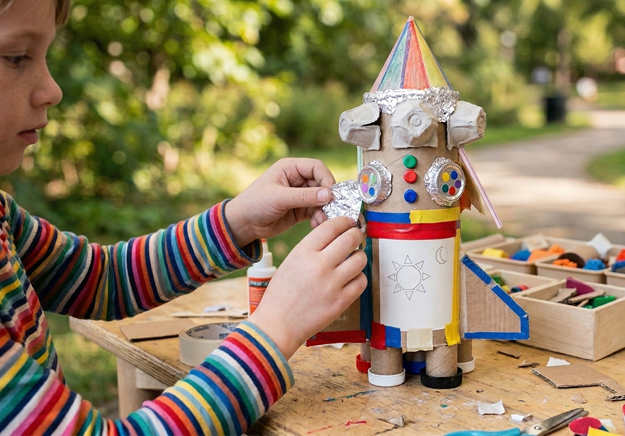
Every parent knows a kid who likes the box more than the toy; that is the ultimate example of loose parts! While “loose parts” can truly mean individual parts that can be remade into a new whole, it can also be thought of like using recycled materials to build new toys.
It’s More Than Just Junk
When a child engages with loose parts, they aren't just playing; they are practicing the engineering design process, the steps engineers follow to find a solution to a problem. Engineering is a large aspect of STEAM play and learning.
Think about it: when a child uses a set of PVC pipes or wooden blocks to build a "rocket," they are naturally moving through STEAM disciplines:
Science: They test gravity and balance.
Technology & Engineering: They explore how pieces fit together to create a functional structure.
Arts: They use their imagination to transform raw materials into something aesthetic or symbolic.
Math: They instinctively sort by size, count pieces, and understand spatial relationships.
In addition to the traditional STEAM principals, loose parts play also encourages collaboration. "I'll hold this tube if you tape it!” is an example of this. Kids are learning how to work together to achieve a common goal of creating something new and exciting.
What Counts as a “Loose Part?”
The beauty of this philosophy is that the materials don't have to be expensive or high-tech. In fact, the simpler they are, the more the brain has to work! You’ll often see loose parts categorized like this:
Nature’s Building Blocks: Pinecones, smooth river stones, sticks, and shells.
The "Recycled" Heroes: Cardboard tubes, egg cartons, fabric scraps, and milk crates.
Constructive Tools: PVC pipes, wooden blocks, colorful scarves, and bungee cords.
Modern Classics: Magnetic tiles, Plus-Plus bricks, Lego, geoboards with rubber bands, and snap circuits.
Constrained Loose Parts
While many loose parts are about building anything you want, we also love using “constrained loose parts,” which bridge the gap between pure imagination and logical problem-solving. Tangrams and Tetris-style bricks with challenge cards are "loose parts with a mission” that promote:
Spatial Reasoning: When a child uses Tetris bricks to match a shape on a card, they are practicing mental rotation; a core skill for future architects and engineers.
Pattern Recognition: Tangrams teach kids to see how smaller geometric shapes combine to create larger, complex images.
The "Frustration Threshold:" Unlike a box of random sticks, a challenge card has a specific right answer. This helps kids build persistence as they try different combinations to solve the puzzle.
How We Bring Loose Parts Play to STEAM Station
At STEAM Station, we believe that physical play and mental creativity should happen in the same breath. That’s why we make open-ended play part of the environment:
Rotating Constrained Loose Parts: We curate specific bins of materials that change regularly to keep the engineering challenges fresh.
Magnetic Tile Stations: Perfect for building complex structures or 3D designs.
Free STEAM-Based Projects: Occasionally, we’ll host self-guided STEM activities where we provide a specific prompt, like “Using these five items, construct a robot and give it a name.” or “With this set of Plus-Plus Bricks, match the picture on the card.”
At STEAM Station, we’ve leaned into this philosophy by design. While we love high-tech interactive games, we know that the "movement" in our movement center isn't just about running and jumping; it’s about the movement of ideas, too.
Our space is intentionally curated with open-ended play materials that allow kids to build their own worlds. Whether they are constructing a house with magnetic tiles or collaborating on a masterpiece between karaoke sessions, we provide the loose parts so they can provide the spark.
Want STEAM-Based Play Ideas Delivered to Your Inbox?
We’re building a community of curious families right here in eastern Wake County. Sign up for the STEAM Station newsletter to get play-based learning tips, behind-the-scenes updates on our location search, and first dibs on founding family memberships!
