

8 Creative and Fun Ways to Keep Kids Learning This Summer
After talking to a friend this evening about educational yet fun ways to keep our kids busy this summer, I thought it might be good to put together a list of some fun options. Our kids are rising first graders, which is such a magical age for discovery! However, you can easily adapt this entire list to fit your own children's unique needs, ages, and skill levels as they gear up for the upcoming school year.
The main goal here is stealth learning; activities that feel like everyday play or games but quietly keep their math, literacy, and critical thinking muscles sharp over the long break. Here are 8 hands-on activities to inspire your summer routine:
1. Sentence in a Jar
Put a variety of words written on small slips of paper into a jar. Have your child choose 2 to 3 slips at random and write a complete sentence using all of the words they selected.
This can easily be scaled shorter with simple sight words or CVC (consonant-vowel-consonant) words. If your children are a bit younger, they can choose just a single word to practice writing or using in a sentence.
This activity is also a phenomenal, low-stress tool if your family is practicing a second language!
Working on things like pencil grip strength, coloring, and working independently? Kids can also draw and/or color a picture to go with their sentence.
2. Domino Math
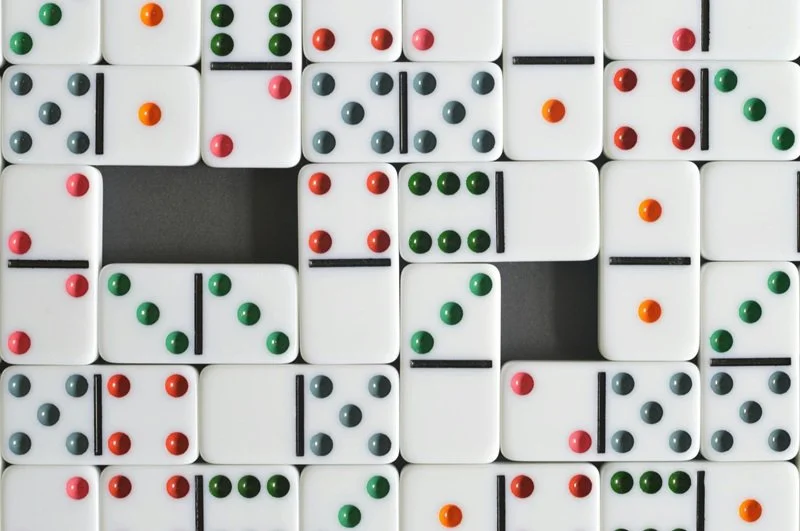
Turn a standard family game of dominoes into an interactive math challenge. As you play, simply add or multiply the number of dots on the ends as you lay them down on the table. For example, if a player matches a 6 with another 6, they can announce out loud: "Six plus six is twelve!" or "Six times six is thirty-six!" before the next turn can be made.
Want to take it up a notch? Add up all the numbers on each domino you’re pairing. 6 + 6 + 3 + 2 = 17, for example.
3. Uno Ice Cream for You
Inspired by an ingenious idea floating around Instagram and Pinterest, this game turns a deck of Uno cards into a sweet math stacker!
Draw a simple cone on a sheet of paper with 9 blank ice cream scoops stacked on top. Create one sheet for each player (at least 2 players total).
On their turn, Player 1 draws an Uno card and writes that number inside their bottom-most ice cream scoop. Player 2 does the same.
On their second turn, Player 1 draws a new card, adds (or multiplies) that number to the value in their first scoop, and writes the new sum in the second scoop. For example, if your first scoop holds a 2, and you draw a 6, your second scoop gets an 8.
Play continues until all players fill their 9-scoop stacks.
At the end, players add up all the final numbers in their cones; the highest score wins!
This can be played with regular cards, too, but Uno cards are bigger and sometimes easier to read for younger kids.
4. Sidewalk Chalk Grid Find
Take the learning outside on a sunny day!
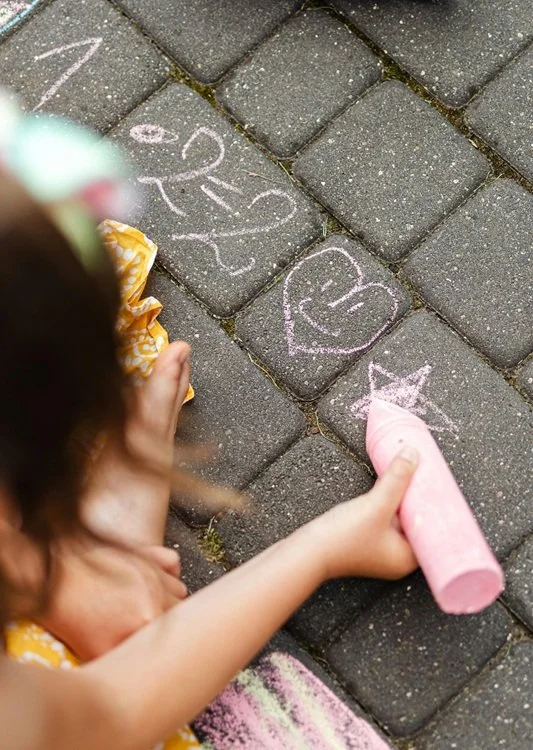
Draw a large grid of numbers, letters, or sight words on your driveway or sidewalk using colorful chalk. Call out a specific target phrase or math problem, such as "Find a word that starts with the 'Sh' sound!" or "Jump to a number that is greater than 15!"
Your child then has to run, hop on one foot, or laser-blast the correct square using a water gun or a wet sponge. It's an excellent way to burn off energy while practicing core academic skills (and beat the heat if you’re playing with water).
5. Tape Track Mazes
Using standard painter's tape, map out a series of intersecting tracks, zig-zags, or geometric shapes right across your living room floor. You can easily adapt this footprint to target different educational goals:
For Math & Reading: Write letters, numbers, or sight words on small sticky notes and place them along the tracks. Have your child navigate a toy car or train along the tape, collecting the notes in correct alphabetical or numerical order.
For Fine Motor & Physics: Hand them a straw and have them blow a small pom-pom or ping-pong ball precisely along the boundaries of the tape from start to finish!
6. The Floor is Lava Pattern Pop
Put a sneaky STEM twist on a classic childhood favorite.
Use colored construction paper or foam floor tiles as "safe stones" spread across the room.
Before your child can cross the "lava," establish a specific pattern rule they must follow (e.g., Red, Blue, Blue, Red, Blue, Blue). To cross successfully, they have to analyze the sequence and step only on the correct next color.
To scale it up for older kids, turn the safe stones into a math skip-counting sequence (like 2, 4, 6, 8) to navigate across:
Setup: Write numbers on pieces of paper (the stones) and scatter them across the floor.
Rule: Tell your child, "To cross the room safely, you have to skip-count by 2s!"
Gameplay: Your child stands at the start. They can see stones with all kinds of numbers on them (like 3, 5, 2, 9, 4, 7, 6). To safely cross without touching the "lava," they can only step on the stones that go in order: 2, then 4, then 6, then 8, and so on.
7. Flashlight Word & Shape Hunt
Tape sight words, simple math equations, or geometric shapes on the walls down a dark hallway or inside a bedroom.
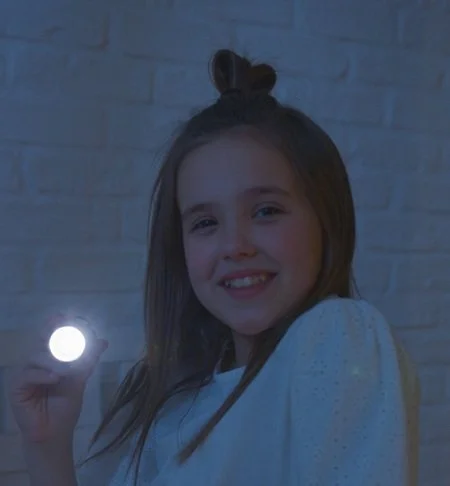
Hand your child a flashlight, turn off the overhead lights, and give them a specific secret mission. You might say: "Find three shapes that have exactly four corners," or "Illuminate the hidden word 'THE'!"
The simple addition of a dark environment and a flashlight instantly transforms basic academic review into an exciting, high-engagement investigation.
8. Shadow Art & Physics
On a bright, clear day, bring a long roll of butcher paper and a bin of your child’s favorite action figures, plastic animals, or building blocks outside. Line the toys up so they cast distinct shadows on the paper, and have your child carefully trace the outlines.
To weave in an awesome earth science lesson, leave the toys in place and check back every couple of hours to observe and discuss how the shadows have stretched, shrunk, or shifted angles based on the sun's position in the sky.
What’s on Your Summer Bucket List?
Keeping our kids engaged over the summer months doesn’t require expensive workbooks or structured classroom hours. Often, the best memories, and the deepest learning, happen when we take simple, everyday items like sidewalk chalk, painter's tape, or a deck of cards and look at them through a creative lens.
Give a few of these a try with your own family, and don't be afraid to experiment and tweak the rules as you go. What are some of your favorite ways to sneak learning into summer play? Let us know on Facebook, and happy summer learning from all of us at STEAM Station!
