
Geometry Through Play
Have you ever noticed how a child’s face lights up when they finally click that last triangular tile into place to finish a tower? There is a specific kind of magic that happens when abstract math concepts move off the whiteboard and into a child’s hands. When we bridge the gap between math and art, geometry stops being about memorizing formulas and starts being about possibility.
By using 3D shapes and patterns, we can help kids see that math isn’t just a subject in school; it’s the literal building block of the world around them. Here are a few favorite ways to bring touchable geometry to life.
Tangrams and Magnetic Tiles
If you’re looking for a starting point, you can’t go wrong with these staples of hands-on learning:
Tangrams: These ancient puzzles are a masterclass in spatial reasoning. By rearranging the seven simple flat shapes or tans (five triangles, one square, and one parallelogram) to create a complex silhouette, kids learn about decomposition; the idea that one large shape can be broken down into many smaller ones. It’s art, it’s a puzzle, and it’s pure geometry.
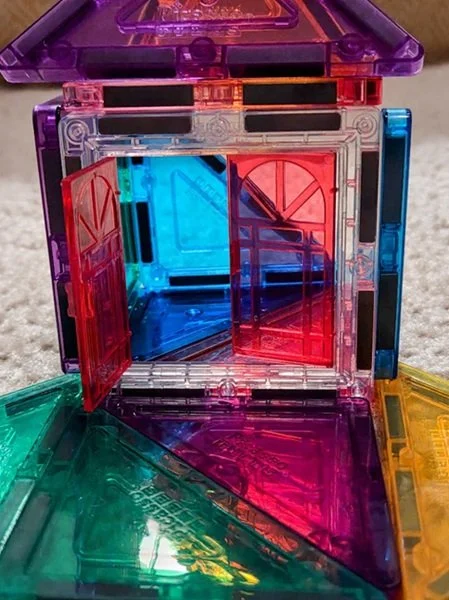
Magnetic Tiles: These are a modern favorite for a reason. They allow kids to effortlessly move from 2D squares and triangles to 3D cubes and pyramids. The click of the magnets provides instant feedback, encouraging kids to experiment with symmetry and structural integrity without the frustration of pieces falling apart.
Expanding the Toolkit: Beyond the Basics
To keep the momentum going, consider introducing these tactile tools to your rotation:
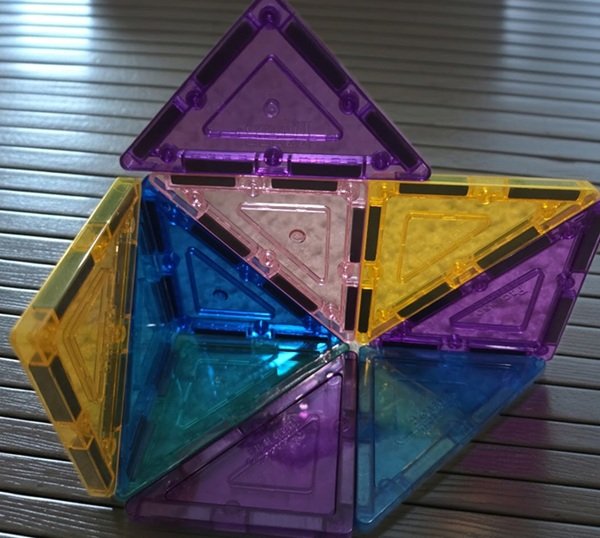
Pattern Blocks: While similar to tangrams, pattern blocks (hexagons, trapezoids, rhombuses) are fantastic for exploring tessellation (creating patterns where shapes fit together perfectly without any gaps). It’s like creating a mosaic where the math does the heavy lifting.
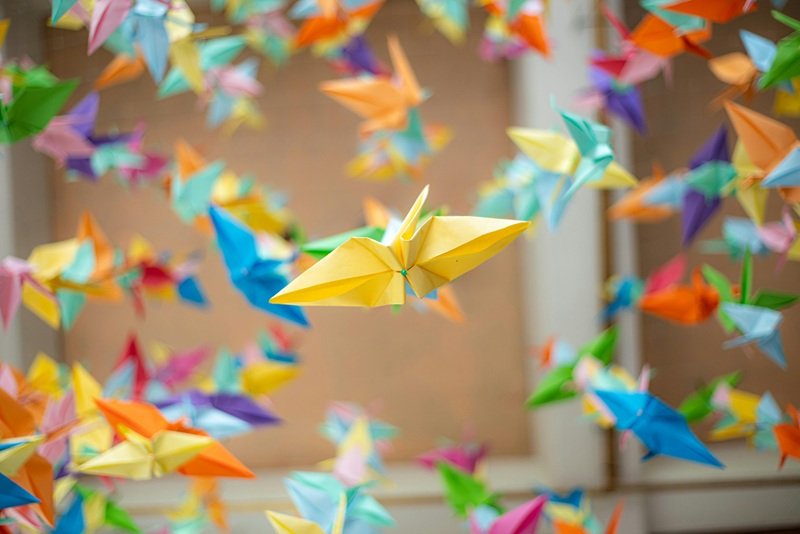
Origami: Paper folding is a beautiful way to explore geometric transformations. Every fold represents a line of symmetry, and watching a flat square transform into a 3D crane or a jumping frog is a lesson in engineering and art all at once.
3D Geometric Solids: Sometimes, just holding a wooden or acrylic sphere, cone, or cylinder makes all the difference. Letting kids trace the faces, count the vertices, and feel the curves helps them internalize the "weight" of geometry.
Why the Art Connection Matters
When we approach math through an artistic lens, we remove the pressure of getting the right answer and replace it with the joy of exploration.
A child building a complex structure with magnetic tiles is calculating balance and weight distribution. A child arranging tangrams is practicing rotation and reflection. They are doing math; they just happen to be having a great time doing it.
By providing these tactile experiences, we aren't just teaching shapes; we’re helping kids develop a sophisticated, nuanced understanding of how the world is constructed. Whether they grow up to be artists, engineers, or anything in between, that foundation of hands-on geometry will stay with them forever.
