
Proprioception Explained
If you’ve recently navigated an ADHD diagnosis or started occupational therapy (OT) appointments with your child, you’ve probably been hit with a tidal wave of new jargon. Words like "executive function," "sensory processing," and “proprioception” (pronounced: pro-pree-o-sep-shun) start appearing in every conversation.
I’ll be honest: I didn’t truly understand what proprioception meant or why it mattered until recently. After countless hours of late-night scrolling and talking with specialists, I realized that this "secret sense" is the reason why some kids seem to constantly crash into furniture, while others can’t stop spinning in circles.
What is Proprioception?
While we all know the five basic senses, proprioception is often called our sixth sense. It is your brain’s ability to know where your body parts are in space without you having to look at them. It’s how you can scratch your nose in the dark or walk up stairs without staring at your feet.
For many kids, especially those with ADHD or sensory processing differences, this internal GPS can be a little fuzzy. They might use too much force when closing a door or feel the need to constantly move to find their body’s boundaries.
The Power of Getting Dizzy
One of the most surprising things I learned is that letting your kids get dizzy is actually a good thing! We often tell kids to stop spinning because it makes us feel lightheaded just watching them, but their brains are actually craving that input.
According to The Natural Parent Magazine, activities like spinning, sliding, and swinging:
"Stimulate the inner ear (vestibular) balance center of the brain. When the inner ear balance centers are stimulated, activity increases in the cerebellum, which controls balance and coordination. It also stimulates the speed at which we think and has important connections with key emotional and memory centers."
When kids use spinning chairs, trampolines, or swings, they aren't just playing; they are calibrating their brains.
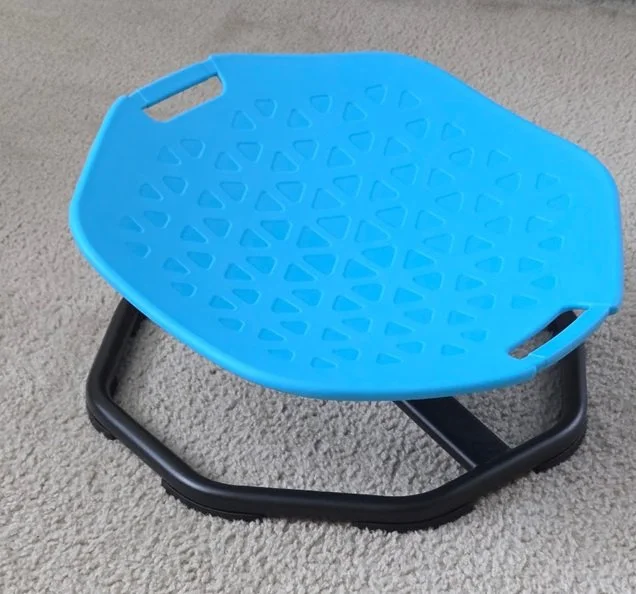
The blue spinning chair at our house that inspired this post today.
The Power of Heavy Work
Heavy work refers to any activity that pushes or pulls against the body. It’s exactly what it sounds like: using our muscles and joints to move against resistance. This deep pressure is like a reset button for the nervous system.
When picturing heavy work, lifting weights or carrying heavy boxes may first come to mind. While these things would be examples for some people, when it comes to kids doing heavy work, we think more about:
climbing playground equipment
using a trampoline
doing animal walks across the floor
pulling a wagon
jumping and landing firmly
bouncing on a yoga ball
The OT Toolbox has a ton of really great ideas when it comes to heavy work for kids.

Calibrating the Internal GPS at STEAM Station
At STEAM Station, we’re intentionally selecting technology that provides vital sensory input that kids need in a safe, high-energy way.
Interactive Floor and Walls: When kids jump to stomp a digital bug or reach high to throw a ball and hit a target on an interactive wall, they are practicing something called graded force. They have to calculate exactly how much power to put into their jump or throw, which sharpens their proprioceptive GPS.
Nex Playground: These games require kids to move their entire bodies in response to what they see on the screen. This cross-body movement strengthens the connection between the left and right hemispheres of the brain, improving overall coordination.
The Scarf Cannon: The act of reaching, tracking a moving object, and bracing the body to catch a falling scarf provides excellent heavy work; the kind of muscle input that helps calm and center a child’s nervous system.
Why It Matters
When a child understands where their body is in space, they feel more secure, confident, and focused. By providing opportunities for big sensory play, the kind that requires reaching, jumping, and muscle resistance, we are helping them calibrate their internal GPS. Whether they are navigating the laser maze or jumping on the interactive floor, these activities help build a stronger, more connected brain that is ready to take on the world.
