

Tactile Feedback vs. Glass Screens: What Really Happens in the Developing Brain?
Picture two play scenarios:
In one, a child sits on the floor, dragging an index finger across a tablet to drop virtual blocks into a digital tower.
In the other, that same child is in a makerspace surrounded by toilet paper tubes, metal washers, pinecones, and river rocks, balancing a heavy, rough stone on top of a smooth cardboard cylinder, catching it before it tips, and adjusting their grip as gravity takes over.

On the surface, both look like problem-solving. But underneath the skull, the brain processes these two activities through vastly different neural pathways.
Here is what developmental neuroscience reveals about dragging a finger across a flat screen versus engaging with physical space and tangible, open-ended materials.
1. The Frictionless Plane: Why Glass Flattens Sensory Input
When a child swipes across a tablet, the visual feedback is dazzling. Colors flash, fireworks burst, and sounds chime. But to the sensory cortex, the experience is nearly uniform:
Homogeneous texture: Every object—whether it looks like water, sandpaper, slime, or steel—feels like cold, polished glass.
Static weight: A digital boulder and a digital feather exert the exact same zero-gram resistance against the fingertip.
Two-dimensional motor loops: The movement repertoire is largely restricted to tapping, pinching, and dragging across an X/Y plane.
The somatosensory cortex, the brain’s map of touch, pressure, and temperature, expects rich, multi-layered feedback whenever the eyes see an object. When a screen shows a squishy sponge but the finger feels rigid glass, the brain experiences sensory mismatch. Over time, heavy reliance on flat glass deprives young hands of the tactile variation they need to calibrate fine motor control.
In fact, developmental research highlights how crucial hands-on exploration is. A study on tactile exploration and screen exposure published in Children found that toddlers with higher screen exposure demonstrated significantly weaker tactile exploration skills and used less mature exploratory strategies than peers engaged with physical alternatives.
2. The Neurological Magic of Proprioception and Loose Parts
When a child shifts from a glass screen to open-ended physical objects, what we call loose parts, the entire nervous system lights up.
As we explore in our deep dive into loose parts play, loose parts are materials that can be moved, manipulated, rearranged, carried, lined up, taken apart, and put back together in endless combinations.
From a neurological standpoint, handling loose parts triggers two critical systems:
Tactile Discrimination
A child grabbing a cardboard toilet paper tube, a smooth glass pebble, and a burlap ribbon must process texture, temperature, compliance (squishiness), and surface friction. This stimulates thousands of mechanoreceptors in the fingertips, building dense neural wiring between the sensory cortex and the motor cortex.
Proprioception
Proprioception is the sensory system that tells your brain where your limbs are in space without looking, mediated by receptors in your muscles, tendons, and joints.
Lifting a light twig requires minimal motor unit recruitment.
Lifting a dense brick or a bucket of stones requires the cerebellum to instantly calculate force, counter-balance the core, and adjust hand pressure so the object doesn't slip.
Glass screens do not offer proprioceptive load. Loose parts, by contrast, demand constant, real-time biomechanical micro-adjustments.
3. Embodied Cognition: We Think With Our Bodies
For decades, traditional cognitive science viewed the brain like a computer that simply processes abstract symbols. But modern neuroscience champions embodied cognition, the theory that our thinking, spatial reasoning, and abstract logic are built directly from bodily sensorimotor experiences.
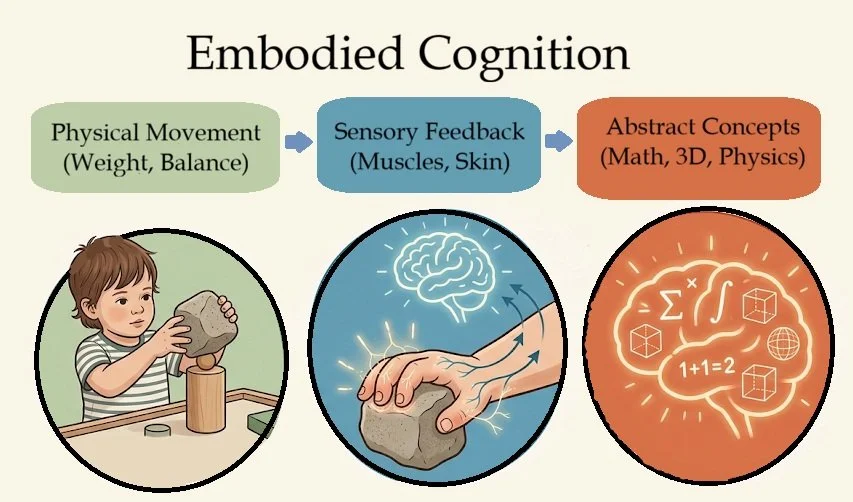
When a child physically fits a wooden dowel through a ring, reaches over their midline to stack a block, or ducks under a fort they just built, they aren't just playing, they are hardwiring spatial awareness, geometry, and executive planning into their neural architecture.
A digital simulation can teach the rule of gravity, but only physical mass can teach the feeling of center-of-mass.
The STEAM Station Takeaway
The hands are the brain's primary ambassadors to the physical world.
While screens are a fixture of modern life, flat glass can never replicate the rich, three-dimensional sensory input of moving weighted, textured objects through physical space.
That is exactly why we are building the Craft Corner at STEAM Station.
It is an open invitation for curious makers of all ages to ditch the frictionless plane for real-world tactile physics. Here, kids can grab fabric scraps, cardboard tubes, tape, and loose hardware, letting their fingers feel the grit of friction, their muscles gauge the pull of mass, and their developing brains build an unshakeable foundation in reality.
